

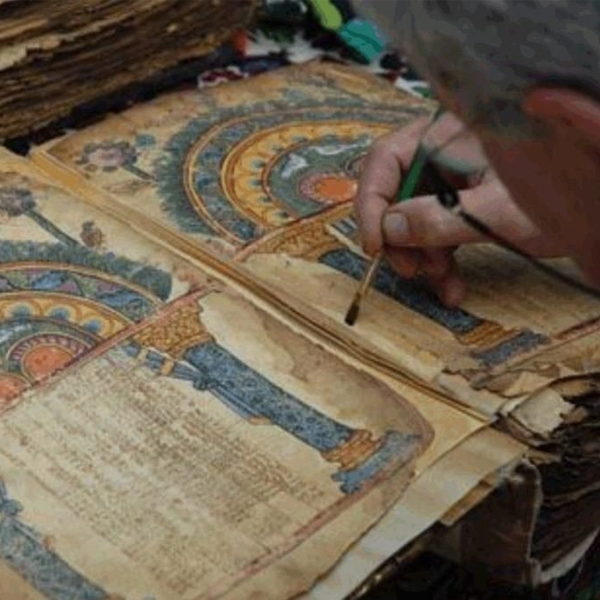
In the heart of Detroit, Michigan, a story of chance and perseverance unfolded when Andrew Joseph Kos embarked on an unanticipated journey that would shape his later years. Having retired from a distinguished career in college teaching, Kos found himself at a crossroads, searching for a meaningful project to channel his intellectual curiosity and creativity.
A Crossroads in Retirement
Kos joined in his retirement with Jake Jacobson, an attorney friend who, also in retirement, was considering the purchase of a yacht for leisurely exploration. Jake shifted course and purchased instead an aging, enigmatic mansion he dubbed “The Castle” and asked Kos to help in exploring the renovations.
The Castle, located in Detroit, was more than a dilapidated property; it was a relic of a bygone era, carrying whispers of forgotten stories within its walls. While its grandeur had faded, its history remained palpable. As Kos was helping Jake explore the renovations of The Castle, he discovered that it contained secrets that had lain dormant for decades—two abandoned manuscripts.
A Fateful Discovery
During the castle explorations, Kos ventured into the cellar of the mansion, a space dimly lit and cluttered with remnants of its former owners. Amid the dust-covered artifacts and discarded possessions, he found a nondescript large cardboard box. The box, taped and unmarked, seemed unassuming at first glance but taped to the top was a smudged handwritten note that told a different story.
Driven by curiosity, Kos untapped the box, revealing its contents—two fragmentary manuscripts written partly in meticulous Gregg Shorthand. Jake decided that Kos’s background in writing and literature made him their logical keeper.
Kos recounts how his familiarity with shorthand, a skill not commonly practiced, allowed him to decode the manuscripts with precision. As he began to examine their contents, he realized the depth and complexity of the works before him. These were not ordinary writings; they were layered texts, reminiscent of his own award-winning book, Hamlin, that captured the essence of a bygone time—a younger version of himself, all richly narrated.
The Mystery of the Manuscripts
The manuscripts, apparently abandoned and hidden away for over fifty years, posed questions that begged for answers. Who was the original author? Why had the works been left behind? What purpose had they served, and why had they been hidden in such an obscure location? These mysteries intrigued Kos, compelling him to delve further into their significance.
Kos would first search out their author, as described in his short story entitled Serendipity, published at the end of this book. The first manuscript, which he would eventually edit and rewrite, joined his award-winning novel, Hamlin. The result was a memoir-romance rooted in the 1960s, published as New Hell & That Moving Finger. It combined a mixture of autobiographical elements with fictionalized accounts, weaving a narrative that explored themes of love, loss, and existential reflection.
The second manuscript, titled The New Hell Project, was an ambitious, unfinished work inspired by Dante’s Inferno. Unlike the first, this manuscript ventured into philosophical and visionary realms, contemplating phenomenology, the collective unconscious, and something dubbed ADI, Artificial Deity Intelligence. It is another blockbuster and will be published as The New Hell Project or The Advent of New Hell.
The Manuscripts’ Dormant History
The fifty-year gap between the manuscripts’ creation and their discovery added a layer of poignancy to the story. These fragments, carefully crafted and painstakingly recorded, had remained unpublished, their potential unrealized. They had been silenced by time and circumstance, left to languish in obscurity.
It was as though they had been waiting for someone uniquely equipped to breathe life into them—a sentiment Kos himself would later express. Kos explains how his background played a pivotal role in his ability to take on this project. His extensive education, including advanced degrees in English, Humanities, and Guidance & Counseling, provided him with the analytical skills necessary to interpret and contextualize the manuscripts.
Additionally, his career—spanning roles as a professor of literature and composition, a humanities lecturer, an art gallery owner, an educator abroad, and a U.S. Army veteran—had honed his understanding of storytelling and human experience.
A Personal Mission
As Kos worked through the manuscripts, he began to project a profound sense of responsibility. He described the experience as being “chosen” for the task, an acknowledgment of the unique intersection of circumstances that had led to this moment.
The manuscripts were not merely historical artifacts or literary relics; they were voices from the past that needed to be heard, stories that deserved to be shared. The decision to edit and publish the manuscripts was not taken lightly. Kos understood the complexities involved in preserving the integrity of the original works while adapting them for a contemporary audience.
He approached the project with the meticulousness of a scholar and the passion of an artist, determined to honor the manuscripts and their legacy.
Breathing Life into the Manuscripts
The process of bringing the manuscripts to light required painstaking effort. Kos spent countless hours transcribing the shorthand into readable text, deciphering nuances that might otherwise have been lost. He also grappled with the challenge of contextualizing the works, bridging the gap between their historical origins and the expectations of modern readers.
Through this process, New Hell & That Moving Finger emerged as a poignant and evocative piece, blending elements of memoir with fictional narrative. Its exploration of personal and societal struggles resonated deeply, offering insights into the human condition that transcended its era.
The other fragment, The New Hell Project or The Advent of New Hell, though still a work in progress, revealed itself as a bold and visionary undertaking, one that pushed the boundaries of traditional storytelling.
A Legacy Revived
The discovery and subsequent publication of New Hell & That Moving Finger marked a significant milestone in Kos’s journey. It was a testament to the enduring power of literature and the unanticipated ways in which stories can find their way into the world.
The manuscripts—abandoned and forgotten—had found their champion in Kos, who transformed them into a vehicle for connection and reflection. The story of these manuscripts is as much about Kos as it is about the works themselves.
It speaks to Kos’s unwavering commitment to intellectual exploration and his belief in the transformative potential of storytelling. Through his efforts, the manuscripts, “abandoned” and “found,” have not only been infused with new life but have also been given a platform to inspire and engage readers across generations.
The “abandoned” manuscripts, as “found” in the cellar of “The Castle,” are more than just relics of the past; they are a call to action, an invitation to bridge the gap between history and the present. For Andrew Joseph Kos, they became a labor of love, a project that allowed him to combine his skills, passions, and experiences in service of a greater purpose.
In unearthing them as forgotten works, Kos has reminded us of the resilience of stories and their ability to endure, even when buried beneath the obscuring weight of time.